 |
 |
 |
 |
 |
 |
 |
 |
 |

 |
Pearl-Like Coating From Oysters Could Protect Aircraft
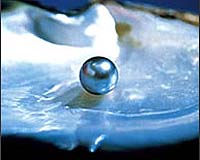
Arlington VA (SPX) Apr 21, 2008 Scientists from the University of Dayton Research Institute have manipulated the process of shell and pearl formation in oysters to demonstrate a method for depositing pearl-like coatings onto various metal surfaces. This biomimetic research could lead to new lightweight, durable coatings able to protect aircraft from impact and corrosion. The significance of this Air Force Office of Scientific Research-funded project is that biological ceramic coatings are naturally derived and do not involve the high-temperature, high-pressure environment required by existing methods for ceramic deposition. The Air Force currently uses protective ceramic coatings on aircraft for various purposes, but officials say a nonhazardous process that creates ceramics at room temperature and pressure would be an interesting alternative. Doug Hansen, a UDRI senior research scientist, is building on a fellow investigator's recent discovery that oysters use blood cells to deposit crystals that form shell and pearl. Clemson University's Dr. Andrew Mount made the discovery, which negated scientists' long-held belief that oysters create their shells by precipitating calcium carbonate from seawater. "We have taken those blood cells and manipulated them to deposit crystals in an ordered manner on a variety of metal surfaces, resulting in a multilayered ceramic coating," Mr. Hansen said. The goal of the program is to understand the process that the cells use to form and deposit these crystals into layers. Mr. Hansen said he hopes to achieve a high level of control over the thickness and placement of the ceramic coatings on materials that require strong but lightweight protection. Mr. Hansen and his wife, Karolyn, also a UDRI senior research scientist, maintain live oysters in their lab and use them to demonstrate ceramic deposition inside and outside of the organism. The Hansens insert small pieces of metal into the oysters, which triggers the formation of pearl. They also take blood cells out of the oysters, which when placed on metal behave as if they are growing a shell on the surface. Mr. Hansen recently reported having successfully deposited multilayer coatings on four different metal surfaces: two aircraft aluminum alloys and two biomedical alloys. Currently the couple is working to characterize the coatings in terms of corrosion resistance, strength and adhesion. They also are developing methods to direct the application of the ceramic films at specific sites on metal surfaces. Maj. Jennifer Gresham, AFOSR program manager, said she hopes this research will lead to a better understanding of how biological systems can formulate ceramic coatings and films. Such knowledge could allow for the development of synthetic processes to deposit ceramic films and coatings without the necessity for high-temperature and high-pressure conditions. Community Email This Article Comment On This Article Related Links The latest in Military Technology for the 21st century at SpaceWar.com
 The Evolution Of Weaponry Is Truly Darwinian Part One
 Washington (UPI) April 21, 2008
 Charles Darwin was right -- at least for weapons systems: Principles of evolution and the struggle for survival of the fittest apply there all the time. Weapons systems have to keep evolving. And when they can't evolve any more -- they die. |
|
|

| The content herein, unless otherwise known to be public domain, are Copyright 1995-2007 - SpaceDaily.AFP and UPI Wire Stories are copyright Agence France-Presse and United Press International. ESA Portal Reports are copyright European Space Agency. All NASA sourced material is public domain. Additional copyrights may apply in whole or part to other bona fide parties. Advertising does not imply endorsement,agreement or approval of any opinions, statements or information provided by SpaceDaily on any Web page published or hosted by SpaceDaily. Privacy Statement |