 |
 |
 |
 |
 |
 |
 |
 |
 |

 |
EQ-36 Counterfire Target Acquisition Radar Undergoes Successful Testing
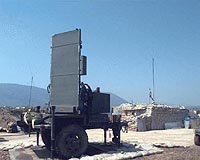
Syracuse NY (SPX) Apr 11, 2008 Syracuse Research Corporation (SRC)'s radar that is the prototype for Lockheed Martin's Enhanced AN/TPQ-36 counter-fire target acquisition (EQ-36) radar recently completed successful performance testing in 360-degree counter-fire mode against mortars and rockets at the U.S. Army's Yuma Proving Grounds in Arizona. The prototype radar was developed by SRC under an Army Technology Objective. Full 360-degree counter-fire tests were performed on the prototype EQ-36 radar; the tests were specifically designed to evaluate the radar's ability to meet U.S. Army requirements outlined in a recent Operation Needs Statement. During the testing, the EQ-36 prototype successfully located the firing positions of both rocket and mortar launchers in 360-degree mode. Live fire testing was conducted over a seven-day period in November and December without a single false alarm. The Army's new EQ-36 radar eventually will provide the capability to detect, classify, track and determine the location of enemy indirect fire, such as mortars, artillery and rockets in either 90-degree or 360-degree modes. EQ-36 systems will replace aging TPQ-36, TPQ-37 and other Cold War era medium-range radars, which only operate in limited 90-degree modes. "Testing of the prototype atYuma has proven that the radar can operate in 360-degree mode, which brings enhanced capabilities to our Soldiers when they are under attack from mortars and rockets," said Bob Roberts, president and chief executive officer of SRC. "We are optimistic that additional testing will further demonstrate the radar's capability and versatility." "By building on SRC's prototype radar, we've drastically shortened the time it will take to develop and deliver EQ-36 to the warfighter," said Carl Bannar, vice president and general manager of Lockheed Martin's Radar Systems business. "EQ-36 is about the Soldier ... the sooner we field this solution, the sooner it can start saving lives." The EQ-36 program remains on a fast track. In January 2007, Lockheed Martin received a contract award for approximately $120 million from the U.S. Army's Program Executive Office - Intelligence, Electronic Warfare and Sensors to provide the U.S. Army with five EQ-36 radars within 36 months. Senior Army officials have told Lockheed Martin that the potential exists for the company to provide the Army with more than 180 EQ-36 radars, valued at more than $1.6 billion. In October, the EQ-36 program completed a successful Preliminary Design Review and Lockheed Martin and SRC debuted the EQ-36 prototype at the Association of the U.S. Army's Annual Meeting in Washington, D.C. Syracuse Research Corporation and Lockheed Martin held the program's Antenna Electronics Critical Design Review (CDR) on schedule the week of January 28. Additional components of the EQ-36 will undergo CDR the week of February 25. Lockheed Martin will deliver the first two EQ-36 systems to the Army by summer 2009; the third and fourth by fall 2009; and the fifth by early 2010. Community Email This Article Comment On This Article Related Links The latest in Military Technology for the 21st century at SpaceWar.com
 Raytheon Awarded Contract To Provide Marines With Persistent Surveillance
 Tewksbury MA (SPX) Apr 11, 2008
U. S. Marines in Iraq will have enhanced ability to detect hostile troop movements thanks to Raytheon's Ground Based Operational Surveillance System (GBOSS). Raytheon has been awarded a $60 million contract option to provide the U.S. Marine Corps with GBOSS elevated sensor systems with networked remote operational capability. |
|
|

| The content herein, unless otherwise known to be public domain, are Copyright 1995-2007 - SpaceDaily.AFP and UPI Wire Stories are copyright Agence France-Presse and United Press International. ESA Portal Reports are copyright European Space Agency. All NASA sourced material is public domain. Additional copyrights may apply in whole or part to other bona fide parties. Advertising does not imply endorsement,agreement or approval of any opinions, statements or information provided by SpaceDaily on any Web page published or hosted by SpaceDaily. Privacy Statement |