
 |
 |
 |
 |
 |
 |
 |
 |
 |

 |
CSA Announces Design Contract With MDA For RADARSAT Constellation
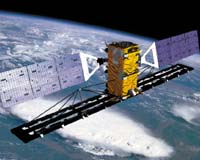
Longueuil, Canada (SPX) Nov 18, 2008 The Canadian Space Agency has announced that MacDonald Dettwiler and Associates (MDA) has been awarded a 16-month contract valued at $40 million to begin the design of the RADARSAT Constellation Mission (RCM). The RADARSAT Constellation is the evolution of the RADARSAT Program and will ensure the continued use by government scientific and commercial clients of data produced by Canada's advanced C-band radar instrument. As part of the mission, the three-satellite configuration will provide complete daily coverage of Canada's land and oceans as well as significant coverage of international areas for Canadian and international users. Like RADARSAT-1 and RADARSAT-2, the Constellation will be designed to function day and night in all weather conditions. It will fully support the priorities of the government and enhance Canada's ability to ensure its sovereignty and security through space-borne maritime surveillance, including the Northwest Passage. "The federal government is proud to support this innovative Canadian-made technology, which will enhance our ability to detect oil spills and monitor floods, landslides and eruptions - and do so in a more timely and comprehensive way than is currently possible," said the Honourable Tony Clement, Minister of Industry. "The announcement further reflects this government's commitment to innovation and technology. The possibilities of use for this sort of technology are many, and our investment in the RADARSAT Constellation Mission demonstrates our desire to remain at the forefront of scientific advancement," said the Honourable Christian Paradis, Minister of Public Works and Government Services. "The development of this constellation will support the government in its efforts to assure sustainable development, manage natural resources, and exercise security and sovereignty, especially in the Arctic," said Steve MacLean, President of the Canadian Space Agency. "It will also allow Canada to continue to contribute significantly to global disaster management and rescue efforts." Under the contract, MDA will complete the preliminary design of the RCM satellite and ground infrastructure. While the initial mission includes three satellites, the Constellation is designed to grow to include up to six satellites. This will allow the system to address future requirements as they arise with greater flexibility. Share This Article With Planet Earth
Related Links Canadian Space Agency Satellite Constellation - multiple satellite deployments in LEO and Beyond
 Iridium Selects Two Companies For NEXT Constellation
 Bethesda MD (SPX) Aug 06, 2008
Iridium Satellite has announced it has selected two companies - Lockheed Martin and Thales Alenia Space - to participate in the final phase of its procurement process for the company's next-generation satellite constellation, "Iridium NEXT." |
|
|

| The content herein, unless otherwise known to be public domain, are Copyright 1995-2007 - SpaceDaily.AFP and UPI Wire Stories are copyright Agence France-Presse and United Press International. ESA Portal Reports are copyright European Space Agency. All NASA sourced material is public domain. Additional copyrights may apply in whole or part to other bona fide parties. Advertising does not imply endorsement,agreement or approval of any opinions, statements or information provided by SpaceDaily on any Web page published or hosted by SpaceDaily. Privacy Statement |
 del.icio.us
 Digg
Digg Reddit
 YahooMyWeb
 Google
 Facebook